Showing posts with label 1972. Show all posts

Monday, May 2, 2011

Subaru Leone, 1972

Subaru Leone, 1972

 
The Subaru Leone is a compact automobile produced by Subaru from June 1971 to February 1989 when it was replaced by the Subaru Loyale, which was essentially the same car, only with a different name. The Leone was known as the "GL/DL" in North America. The Leone was offered in sedan and hardtop coupe format from launch and station wagon format starting in September 1972.

This nameplate covered three generations of compact Subaru; the dates given below are for North American-market vehicles.

    * 1972 model year - GF hardtop coupe offered alongside existing G-series sedans and wagon.
    * 1973 model year; G series replaced by new (Loyale) two- and four door sedans and 5-door wagon.
    * 1975 model year - All-wheel drive wagon offered.
    * 1978 - AWD-only pickup added, marketed as Subaru Brat in North America and Subaru Brumby in Australia. Sedans and wagons offered in plainer DL and fancier GL trim.
    * 1980 - SECOND GENERATION - restyled body for passenger cars. Two-door sedan dropped, replaced by 3-door hatchback on a shorter wheelbase than the others, available with AWD. Pickup continues on old body. 5-speed manual transmission supplied with 2WD GL sedans and wagon and GLF hardtop.
    * 1982 - Pickup now restyled, catches up with passenger cars.
    * 1983 - GL now midlevel trim, fancier GL-10 trim for all bodystyles replaces hardtop-only GLF. Turbocharged engine ("Turbo-Traction") available on AWD GL-10s. AWD now available on sedans and hardtops, and with 5-speed or automatic transmission for the first time. Minor trim changes for all models include "honeycomb" grille texture, Mercedes-style ribbed taillight lenses, and plastic-covered bumpers (except North American 2wd models). GL and GL-10 now have quad headlights.
    * 1985 - THIRD GENERATION sedan and wagon with larger, angular body. Quad headlights now on base DL, composite headlights on GL and GL-10. Hardtop discontinued, second gen. hatchback and pickup continue without change.

The Leone soon became a success in areas where people wanted four wheel drive (4WD), but didn't want a larger car. It soon became the world's top-selling 4WD.

A nice feature about the car is that you can enable/disable the 4WD as you drive with a button on the gear shifter. When the car is not in 4WD mode it is in FWD (Front Wheel Drive) mode. This is much more economical since the engine doesn't have to power both the front and rear axle. So if you are getting to a steep hill you just enable 4WD and you climb up the hill with ease.

Another smart feature is the hill-holder. With this you don't have to hold the break when standing in a hill. You only hold in the clutch and press the breake once, the car will then automatically hold the break, helping you get a better start. The car is powered by a water-cooled, horizontally-opposed, 4-cylinder OHV engine.

The first Subaru Legacy was originally intended to be a Leone replacement, but the car was moved upmarket. The Leone remained in production until 1993, when the slightly smaller Subaru Impreza replaced it.

Saturday, April 9, 2011

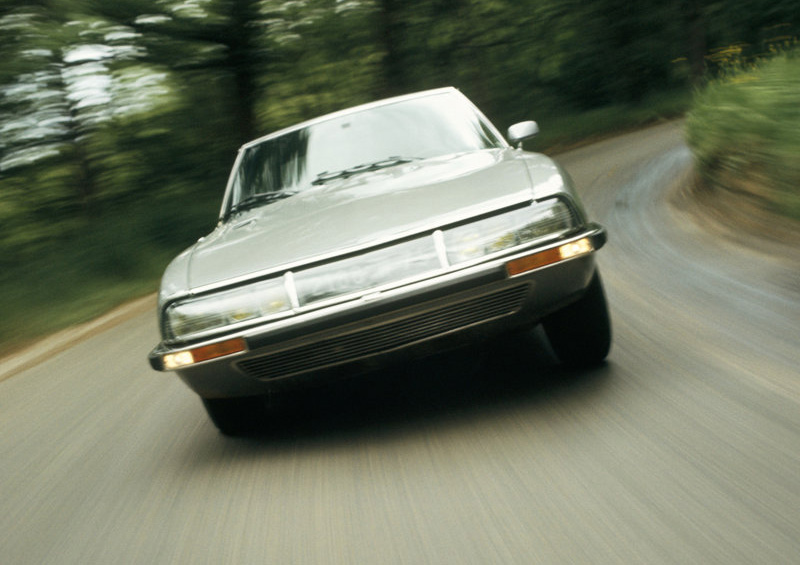
Citroen SM Presidential, 1972

Citroen SM Presidential, 1972


The Citroën SM was a high performance coupé produced by the French manufacturer Citroën between 1970 and 1975. The SM placed third in the 1971 European Car of the Year contest, trailing its stablemate Citroën GS, and won the 1972 Motor Trend Car of the Year award in the US in 1972.

In 1961, Citroën began work on 'Project S' - a sports variant of the revolutionary Citroën DS. As was customary for the firm, many running concept vehicles were developed, increasingly complex and upmarket from the DS - eventually becoming a halo vehicle for the brand. Citroën purchased Maserati in 1968 with the intention of harnessing Maserati's high performance engine technology to produce a true Gran Turismo car, combining the sophisticated Citroën suspension with a Maserati V6 engine.

The result was the Citroën SM (Sport Maserati), first shown at the Geneva Motor Show in March1970. It finally went on sale in France in September of that year. All produced were left-hand-drive, although some RHD conversions were done in the UK.
The SM was Citroën's flagship vehicle, competing with other high performance GTs of the time from manufacturers such as Jaguar, Lotus and Porsche. It was also Citroën's way of demonstrating just how much power and performance could be accommodated in a front-wheel drive design.

The SM innovated a new type of variable assist power steering that has since spread throughout the vehicle population. It allowed great assistance to the motorist while parking, but little assistance at motorway speeds. The steering actually had the same "assist" at all speeds - the steering was hydraulically locked against steering movement of the wheels from the road ("feedback") up to the capacity of the unit. Hitting a chuckhole at high speed would not turn the steering wheel in the driver's hands! The hydraulic pressure to the power centering unit increased with speed, giving the impression of less and less power "assist." Enough pressure was admitted to the centering unit to return the wheels to the straight ahead position when the car was not moving. The centering pressure was regulated by a flyweight centrifugal governor driven by the pinion (secondary) shaft of the manual gearbox and by a proportioning valve connected to the pressure in the automatic gearbox, which pressure was proportional to the speed of the output shaft.

Contemporary automotive journalists were most effusive about the SM's dynamic qualities, which were unlike anything they had experienced prior. The SM provided a combination of comfort, sharp handling, and high performance not available in any other car at the time. Popular Science noted that the SM had the shortest stopping distance of any car they had tested. To this day this stopping distance remains outstanding.

Unfortunately, the SM did not find a sufficient customer base in the European GT market, but much of the SM's technology was carried forward to the successful Citroën CX, launched in 1974 - the DIRAVI steering being the most obvious example. The same basic engine in enlarged 3.0 L form (some in Italy had 2 litre) was used in Maserati's own Merak which, together with the Khamsin, used Citroën's high pressure hydraulics.

Styling
The look of the car was quite distinct. Designed in-house by Citroën's chief designer Robert Opron, the SM bore a vague family resemblance to the DS. Seen from above, the SM resembled a teardrop, with a much wider track at the front.
The SM was unusually aerodynamic for its era, with a very low drag coefficient. European critics marvelled at the resulting ability to travel for hours at 200 km/h (120 mph) in comfort. In addition, many of the details reflected Robert Opron's American background, notably the truncated 'fins' at the rear.

Citroen SM, 1972

Citroen SM, 1972


The Citroën SM was a high performance coupé produced by the French manufacturer Citroën between 1970 and 1975. The SM placed third in the 1971 European Car of the Year contest, trailing its stablemate Citroën GS, and won the 1972 Motor Trend Car of the Year award in the US in 1972.

In 1961, Citroën began work on 'Project S' - a sports variant of the revolutionary Citroën DS. As was customary for the firm, many running concept vehicles were developed, increasingly complex and upmarket from the DS - eventually becoming a halo vehicle for the brand. Citroën purchased Maserati in 1968 with the intention of harnessing Maserati's high performance engine technology to produce a true Gran Turismo car, combining the sophisticated Citroën suspension with a Maserati V6 engine.

The result was the Citroën SM (Sport Maserati), first shown at the Geneva Motor Show in March1970. It finally went on sale in France in September of that year. All produced were left-hand-drive, although some RHD conversions were done in the UK.

The SM was Citroën's flagship vehicle, competing with other high performance GTs of the time from manufacturers such as Jaguar, Lotus and Porsche. It was also Citroën's way of demonstrating just how much power and performance could be accommodated in a front-wheel drive design.

The SM innovated a new type of variable assist power steering that has since spread throughout the vehicle population. It allowed great assistance to the motorist while parking, but little assistance at motorway speeds. The steering actually had the same "assist" at all speeds - the steering was hydraulically locked against steering movement of the wheels from the road ("feedback") up to the capacity of the unit. Hitting a chuckhole at high speed would not turn the steering wheel in the driver's hands! The hydraulic pressure to the power centering unit increased with speed, giving the impression of less and less power "assist." Enough pressure was admitted to the centering unit to return the wheels to the straight ahead position when the car was not moving. The centering pressure was regulated by a flyweight centrifugal governor driven by the pinion (secondary) shaft of the manual gearbox and by a proportioning valve connected to the pressure in the automatic gearbox, which pressure was proportional to the speed of the output shaft.

Contemporary automotive journalists were most effusive about the SM's dynamic qualities, which were unlike anything they had experienced prior. The SM provided a combination of comfort, sharp handling, and high performance not available in any other car at the time. Popular Science noted that the SM had the shortest stopping distance of any car they had tested. To this day this stopping distance remains outstanding.

Unfortunately, the SM did not find a sufficient customer base in the European GT market, but much of the SM's technology was carried forward to the successful Citroën CX, launched in 1974 - the DIRAVI steering being the most obvious example. The same basic engine in enlarged 3.0 L form (some in Italy had 2 litre) was used in Maserati's own Merak which, together with the Khamsin, used Citroën's high pressure hydraulics.

Styling
The look of the car was quite distinct. Designed in-house by Citroën's chief designer Robert Opron, the SM bore a vague family resemblance to the DS. Seen from above, the SM resembled a teardrop, with a much wider track at the front.

Tuesday, March 22, 2011

Citroen DS 21, 1972

Citroen DS 21, 1972


The Citroën DS (also known as Déesse, or Goddess, after the punning initials in French) was an automobile produced by the French manufacturer Citroën between 1955 and 1975. Citroën sold nearly 1.5 million D-series during its 20 years of production.The DS is well-known for its futuristic, aerodynamic body design, and for its innovative technology (including its hydropneumatic self-leveling suspension system).

The DS advanced the achievable standards in terms of ride quality, roadholding, handling, and braking in an automobile. Automotive journalists of the time often noted that competitors took decades to adapt to the higher standards it set. The smooth, aerodynamic body lines gave the car a futuristic appearance. While it looked very unusual in 1955, public tastes appear to have caught up with the DS in the post-Ford Taurus/Audi 100 era.

Model history
After 18 years of development in secret as the successor to the venerable Traction Avant, the DS 19 was introduced on October 5, 1955 at the Paris Motor Show. The car's appearance and innovative engineering captured the imagination of the public and the automobile industry almost overnight. 743 orders were taken in the first 15 minutes of the show, and orders for the first day totalled 12,000.

Far from being just a fascinating technology in search of a purpose, contemporary journalists were effusive in noting how the DS dramatically pushed the envelope in the ride vs. handling compromise possible in a motor vehicle.

The high price tag, however, hurt general sales in a country still recovering from World War II 10 years earlier, and a submodel, the ID (another pun: in French, Idée, or Idea), was introduced in 1957 to appeal to more cost-conscious buyers. The ID shared the same body with the DS, but had more traditional features under the hood. It had no power steering (though this was added as an option later), and instead of the hydraulically controlled manual transmission and clutch, it had a conventional clutch and transmission. Interestingly, the first model series was called 11D, a clear reminder of the last model of the Traction Avant, the 11C. A station wagon variant, the ID Break, was introduced in 1958.

Outside of France, the car's radical and cosmopolitan design appealed to non-conformists. A United States advertisement summarised this selling point: "It takes a special person to drive a special car".

Throughout its model lifetime, the DS managed to remain ahead of its time. It featured power disc brakes, a hydropneumatic suspension including an automatic levelling system and variable ground clearance, power steering and a semi-automatic transmission. A fiberglass roof reduced weight transfer. Inboard front brakes (as well as an independent suspension) reduced unsprung weight. Different front and rear track widths and tire sizes reduced the understeer typical of front-engined and front-wheel drive cars.

Despite the rather leisurely acceleration afforded by its small four-cylinder engine, the DS was successful in motorsports like rallying, where sustained speeds on poor surfaces are paramount.

The DS came in third in the 1999 Car of the Century competition, recognizing the the world's most influential auto designs. Winner and second place went to the Ford Model T and the Mini. It placed fifth on Automobile Magazine "100 Coolest Cars" listing in 2005.

Technical innovations

Hydraulic system
The hydraulic system of the DS 19 was a revolution. Previously hydraulics had been restricted to use in brakes and power steering; the DS used them for the suspension, clutch and transmission. The later ID19 had manual steering and a simplified power braking system.

Suspension
At a time when few passenger vehicles had caught up with the four-wheel independent suspension of the Traction Avant, the application of the hydraulic system to the car's suspension system to provide true self-levelling was a stunning move. This application - 'hydropneumatic suspension' - was pioneered the year before on the rear of the top of range Traction Avant 15CV-H.
At first it was often described as air/oil suspension, since both elements played a key role.

Each wheel was connected not to a spring, but to a hydraulic suspension unit consisting of:
    * a sphere of about 12 cm in diameter containing pressurised nitrogen
    * a cylinder containing hydraulic fluid screwed to the suspension sphere
    * a piston inside the cylinder connected by levers to the suspension itself
    * a damper valve between the piston and the sphere

A membrane in the sphere prevented the nitrogen from escaping. The motion of the wheels translated to a motion of the piston, which acted on the oil in the nitrogen cushion and provided the spring effect. The damper valve took place of the shock absorber in conventional suspensions.

The hydraulic cylinder was fed with hydraulic fluid from the main pressure reservoir via a height corrector, a valve controlled by the mid-position of the anti-roll bar connected to the axle. If the suspension was too low, the height corrector introduced high-pressure fluid. If it was too high, it released fluid back to the fluid reservoir. In this manner, it maintained a constant height. A control in the cabin allowed the driver to select one of five heights:
    * normal riding height.
    * two slightly higher riding heights, for poor terrain.
    * two extreme positions for changing wheels.

The DS did not have a jack for lifting the car off the ground. Instead, the hydraulic system enabled wheel changes with the aid of a simple adjustable stand.

Source and reserve of pressure
The central part of the hydraulic system was the high pressure reservoir, which maintained a pressure of between 130 and 150 bar in two accumulators. These accumulators were very similar in construction to the suspension spheres. One was dedicated to the brakes, and the other ran the other hydraulic systems. Thus in case of a hydraulic failure (a surprisingly infrequent occurrence), the first indication would be that the steering became heavy, followed by the gearbox not working; only later would the brakes fail.

Hydraulic fluid
The original hydropneumatic system used a vegetable oil (LHV or liquide hydraulique végétale) similar to that used in other cars at the time. Very soon, Citroën changed to using a synthetic fluid (LHS or liquide hydraulique synthétique). Both of these had the disadvantage that they are hygroscopic, as is the case with most brake fluids. Disuse allows water to enter the hydraulic components causing deterioration and expensive maintenance work. The difficulty with hygroscopic hydraulic fluid was exacerbated in the DS/ID due to the extreme rise and fall in the fluid level in the reservoir, which went from nearly full to nearly empty when the suspension "got up" and the 6 accumulators in the system filled with fluid. With every "inhalation" of fresh moisture- (and dust-) laden air, the fluid absorbed more water. In August 1967, Citroën introduced a new mineral oil-based fluid LHM, or liquide hydraulique minérale. This fluid was much less aggressive on the system and it remains in use to the present day.

Briefly illegal in the United States (US federal law requires motor vehicle brake fluid to be red - an exception had to be granted to Citroën), LHM has since been adopted by manufacturers like Rolls-Royce, Jaguar, BMW, and Audi under different labels, like "Total," "Pentosin," and others.

LHM required completely different materials for the seals. Using either fluid in the incorrect system would completely destroy the hydraulic seals very quickly. To help avoid this problem, Citroën added a bright green dye to the LHM fluid and also painted all hydraulic elements bright green. The former LHS parts were painted black.
Several different hydraulic pumps were used. The DS used a seven-cylinder axial piston pump driven off two belts and delivering 175 bar of pressure. The ID19, with its simpler hydraulic system, had a single cylinder pump.

Gearbox and clutch
The mechanical aspects of the gearbox and clutch were completely conventional and the same elements were used in the ID 19.

The gear change control consisted of:
    * Hydraulic gear selector.
    * Clutch control. This was the most complicated part. The speed of engagement of the clutch was controlled by:
    * A centrifugal regulator, sensing engine rpm and driven off the camshaft by a belt
    * The position of the butterfly valve in the carburettor (i.e. the position of the accelerator)
    * The brake circuit: when the brake was pressed, the engine idle speed dropped to a rpm below the clutch engagement speed, thus preventing friction while stopped in gear at traffic lights. When the brake was released, the idle speed increased to the clutch dragging speed. The car would then "creep" much like automatic transmission cars. This drop in idle throttle position also caused the car to have more engine drag when the brakes were applied even before the car slowed to the idle speed in gear, preventing the engine from "pulling" against the brakes.

Wednesday, March 2, 2011

Buick silver Arrow Concept, 1972

Buick silver Arrow Concept, 1972


Buick silver Arrow Concept, 1972

Sunday, January 23, 2011

Lotus Esprit Concept, 1972

Lotus Esprit Concept, 1972


The Lotus Esprit was a sports car built by Lotus in the United Kingdom from 1976 to 2004. The silver Italdesign concept that eventually became the Esprit was unveiled at the Turin Motor Show in 1972, and was a development of a stretched Lotus Europa chassis. It was among the first of designer Giorgetto Giugiaro's polygonal "folded paper" designs. Originally, the name Kiwi was proposed, but in keeping with the 'E...' naming format of Lotus tradition, the name became Esprit.

Tuesday, December 21, 2010

Datsun 240z, 1972

Datsun 240z, 1972

 Datsun 240z, 1972