Showing posts with label 2002. Show all posts

Sunday, April 10, 2011

MG X-Power SV Concept, 2002

MG X-Power SV Concept, 2002


MG X-Power SV Concept, 2002

Wednesday, April 6, 2011

Oldsmobile Intrigue, 2002

Oldsmobile Intrigue, 2002


The Oldsmobile Intrigue was a mid-size sedan manufactured from 1998 through 2002 by the Oldsmobile division of General Motors. The Intrigue's design cues were first seen in 1995 with the Oldsmobile Antares concept car. The Intrigue was the first casualty in the phase-out process of Oldsmobile.

Engines
    * 1998-1999 OHV 3.8 L L36 (231 in³) V6
    * 1999-2002 DOHC 3.5 L LX5 (214 in³) V6

Year-to-year changes
    * 1999: For the beginning of this model year, the DOHC 3.5 L "Shortstar" engine was standard in the top-line GLS and optional on mid-level GL and base GX models. Later, it became standard on all models. Decklids now wore Oldsmobile badge (in the previous model year, there was a complaint that some people couldn't tell that Intrigues were Oldsmobiles). All models now got a thicker, leather-wrapped steering wheel. New to the option list was GM's OnStar emergency/communications system.
    * 2000: New to the option list for 2000 was an antiskid system called the Precision Control System. Precision Control System was designed to help keep the car on its intended path by selective braking of one or more individual wheels. Though optional on all models, GX buyers had to order optional traction control to get the new antiskid system. Heated power front seats were now standard on GLS models. Retained accessory power was standard this year. "Oldsmobile" emblem on deck lid is larger than on 1999 models. A new gold-trim package was also available.
    * 2001: On GX models, traction control became optional instead of standard. New standard automatic headlights were now standard on all models. Premium Leather and Precision Sport option packages were also available for this year.
    * 2002: GLS models now featured a two-tone interior with sterling accents, as well as standard Homelink, sunroof, and driver lumbar. All models featured new family of radios with RDS and standard CD player (borrowed from the newly-redesigned Aurora). Tropic Teal and Indigo Blue were two new exterior colors. All models had new LATCH (Lower Anchor and Top tether for Children) in three rear seat positions. Sun & Sound package was available on GL models (includes Bose sound system and sunroof). New winchester headliner was inside. Production of the Intrigue ended in June 2002 as part of the phaseout of the Oldsmobile brand.

Saturday, April 2, 2011

Oldsmobile Bravada Indy Pace Car, 2002

Oldsmobile Bravada Indy Pace Car, 2002


The Bravada was a luxury SUV from the Oldsmobile marque of General Motors. There have been two different vehicles to bear this model name, the first and second-generation GMT330, and the 2002 to 2004 GMT360.

1991
The 1991 Bravada was an upscale version of the then-new 4-door S-Blazer/Jimmy. It was the first truck-based vehicle offered by Oldsmobile since the 1920s, and by that time was a United States-only vehicle. Unlike its siblings, the Bravada was only offered with "Smart Trak" all-wheel drive, leather upholstery, and the 4.3 L Z-code engine. Anti-lock brakes and remote keyless entry were also standard. This version was produced through 1994.

Engines
    * 1991 - 4.3 L Vortec 4300 V6, TBI, 160 hp (119 kW)/230 ft·lbf (312 N·m) (VIN Z)
    * 1992-1994 - 4.3 L Vortec 4300 V6, CPFI, 200 hp (149 kW) (VIN W)

Fuel Economy
The first generation Bravada with the 160 hp engine averaged EPA city/highway 17/22 mpg. The first generation with the 200 hp engine averaged 16/21 mpg.

1996
The Bravada was refreshed later than the others, with no 1995 models produced. The 1996 and 1997 models were less boxy than their predecessor. Daytime running lamps were standard fare including a driver's airbag. The interior styling was more appealing to the eye with less ridges and squares, much like the exterior. Another refreshening occurred in 1998, with a revised interior including dual airbags and a new front fascia which included the new Aurora inspired Oldsmobile logo. OnStar was available in 1999 as a cell phone unit, later becoming integrated into the rearview mirror in 2001 with available features like hands-free calling and virtual advisor. A Bose sound system was added for 1999 and the engine was redesigned in 2000, though output remained the same. A new two-tone exterior dubbed the Platinum Edition was made available in 2000. This generation was phased out in 2001 to make way for the new GMT360 Bravada.

Engines
    * 1996-2001 - 4.3 L Vortec 4300 V6, CSFI, 190 hp (142 kW)

Fuel Economy
The second generation Bravada EPA city/highway averaged 16/21 mpg.

2002
The 2002 Bravada was the first GMT360 truck. The generation Bravada holds the distinction of the last new Oldsmobile model. Like the Chevrolet TrailBlazer and GMC Envoy, it used the new 270 hp (201 kW) Atlas I6 engine. Rear-wheel drive was available for the first time as well, making this the first rear wheel drive Oldsmobile since the 1992 Custom Cruiser. The Bravada entered the Canadian market that time. Production of the Bravada ended with the demise of the Oldsmobile marque in 2004; the last Bravada rolled off the assembly line in January of that year.

Engines
    * 2002-2004 LL8 4.2 L (256 in³) I6, 270 hp (201 kW)

Fuel Economy
The third generation Bravada EPA city/highway averaged 15/21 mpg.

Friday, April 1, 2011

Oldsmobile Bravada, 2002

Oldsmobile Bravada, 2002

 
 The Bravada was a luxury SUV from the Oldsmobile marque of General Motors. There have been two different vehicles to bear this model name, the first and second-generation GMT330, and the 2002 to 2004 GMT360.

1991
The 1991 Bravada was an upscale version of the then-new 4-door S-Blazer/Jimmy. It was the first truck-based vehicle offered by Oldsmobile since the 1920s, and by that time was a United States-only vehicle. Unlike its siblings, the Bravada was only offered with "Smart Trak" all-wheel drive, leather upholstery, and the 4.3 L Z-code engine. Anti-lock brakes and remote keyless entry were also standard. This version was produced through 1994.

Engines
    * 1991 - 4.3 L Vortec 4300 V6, TBI, 160 hp (119 kW)/230 ft·lbf (312 N·m) (VIN Z)
    * 1992-1994 - 4.3 L Vortec 4300 V6, CPFI, 200 hp (149 kW) (VIN W)

Fuel Economy
The first generation Bravada with the 160 hp engine averaged EPA city/highway 17/22 mpg. The first generation with the 200 hp engine averaged 16/21 mpg.

1996
The Bravada was refreshed later than the others, with no 1995 models produced. The 1996 and 1997 models were less boxy than their predecessor. Daytime running lamps were standard fare including a driver's airbag. The interior styling was more appealing to the eye with less ridges and squares, much like the exterior. Another refreshening occurred in 1998, with a revised interior including dual airbags and a new front fascia which included the new Aurora inspired Oldsmobile logo. OnStar was available in 1999 as a cell phone unit, later becoming integrated into the rearview mirror in 2001 with available features like hands-free calling and virtual advisor. A Bose sound system was added for 1999 and the engine was redesigned in 2000, though output remained the same. A new two-tone exterior dubbed the Platinum Edition was made available in 2000. This generation was phased out in 2001 to make way for the new GMT360 Bravada.

Engines
    * 1996-2001 - 4.3 L Vortec 4300 V6, CSFI, 190 hp (142 kW)

Fuel Economy
The second generation Bravada EPA city/highway averaged 16/21 mpg.

2002
The 2002 Bravada was the first GMT360 truck. This generation Bravada holds the distinction of the last new Oldsmobile model. Like the Chevrolet TrailBlazer and GMC Envoy, it used the new 270 hp (201 kW) Atlas I6 engine. Rear-wheel drive was available for the first time as well, making this the first rear wheel drive Oldsmobile since the 1992 Custom Cruiser. The Bravada entered the Canadian market that time. Production of the Bravada ended with the demise of the Oldsmobile marque in 2004; the last Bravada rolled off the assembly line in January of that year.
The Bravada bodyshell is still in production as the Buick Rainier.

Engines
    * 2002-2004 LL8 4.2 L (256 in³) I6, 270 hp (201 kW)

Fuel Economy
The third generation Bravada EPA city/highway averaged 15/21 mpg.

Sunday, March 13, 2011

Oldsmobile Aurora, 2002

Oldsmobile Aurora, 2002

The Oldsmobile Aurora was a luxury automobile made by the Oldsmobile division of General Motors and launched in 1995 to replace the discontinued Toronado 2-door personal luxury coupe. It was a luxurious 4-door sedan riding on the same Cadillac-derived G platform as the 2-door Buick Riviera. Since the demise of the Ninety Eight in 1996, the Aurora became the flagship Oldsmobile. Also, in a way it is the successor of the Ninety-Eight or the Eighty-Eight (at least for 2000). A V6-powered version was introduced in 2001 to supplant the Eighty-Eight and the LSS. It was introduced to bring new life to Oldsmobile, but the first few years of Aurora did not even feature the Oldsmobile name. There was even a rumor at the time that the name of the whole Oldsmobile marque would be changed to simply "Aurora."

Second Generation
Oldsmobile's original intention for the second generation was to move the Aurora further upmarket, retaining its V8-only drivetrain and sharing a platform with the new Buick Riviera, as the original Aurora had done. This would have created more room within the Oldsmobile lineup for a four-door Eighty-Eight successor known as the Antares. However, Buick dropped its Riviera development plans and fiscal trouble found Oldsmobile, so Oldsmobile was forced to re-engineer the Antares into an acceptable Aurora in short time. The Aurora was downsized as the successor for the H-body Eighty-Eight on the short-wheelbase G-body (on which the Buick LeSabre and Pontiac Bonneville joined, as they used to be on the H-body). The 2001 Aurora is the product of that re-engineering.

The second-generation Aurora used a new, less-expensive version of the G platform with a shorter wheelbase. Unlike the original Aurora, this platform was shared with other GM divisions, with Buick offering the Park Avenue and LeSabre, and Pontiac offering the Bonneville.

Oldsmobile also offered a V6 engine in the Aurora for the first time. The V6 in question was the LX-5, a cut-down relation of the DOHC Aurora V8, dubbed the "Shortstar." The V6-powered Aurora was produced for the 2001 and 2002 model years only, with production ceasing in mid-2002.

The second generation Aurora went into production on November 10, 1999. The last Aurora 3.5s rolled off the assembly line on June 21, 2002. The Final 500 Aurora 4.0s ended production on March 28, 2003. The Orion, Michigan plant built a total of 71,722 second-generation Auroras (53,640 in 2001, 10,865 in 2002, 7,217 in 2003).

Engines
    * 2001-2002 LX5 3.5 L (214 in³) V6, 215 hp @ 5600 rpm, 230 ft·lbf torque @ 4400 rpm.
    * 2001-2003 L47 4.0 L (244 in³) V8, 250 hp @ 5600 rpm, 260 ft·lbf torque @ 4400 rpm.

Friday, March 11, 2011

ABT Audi TT-Limited Wide Body, 2002

ABT Audi TT-Limited Wide Body, 2002


Abt TT-limited wide body. From the race track to the road.

Two well-known Abt highlights played a role in the concept of the TT-limited wide-body: the TT-Sport and the TT-limited. In the past few month, both of them have attracted many customers and even more fans. With the limited wide body, the Abt team is now showing a spectacular synthesis of its two most extreme tuning versions of the TT. Thus, the successful company from Kempten demonstrates the state-of-the-art in TT-tuning.

This becomes also clear to the average layman, who might be led to believe that the TT-limited wide-body has got lost from the race track directly on the open road. Responsible for this is the spectacular bodywork kit. As a result of extensive wind tunnel tests, the specialists from Kempten have established an aerodynamic kit, which results into more downforce and therefore a better road-holding. No matter if on local roads or on the motorway. And, of course, on the race track. For instance at the Nurburgring, where Laurent Aiello has scored two brilliant victories for the Team Abt Sportsline with the Hasseroder-yellow Abt-Audi TT-R. The limited wide body not only shares the front spoilers and the extended fenders with the race car, but also the side skirts, a rear wing and a complicated diffuser, which gives downforce at the rear. The several carbonfibre parts also add to the racy feeling.

Aerodynamics, suspension and the impressive sport braking system - all of this serves for controlling the fireworks, that the Abt-technicians are lighting underneath the bonnet. 228 kW (310 hp) are the result of a power boost, that turns the standard 165 kW (225 hp) strong engine into a racing machine. An Abt turbocharger with intercooler and exhaust system allow the standard power plant to breathe freely. A top speed of approx. 254 kph and an acceleration from 0-100 kph in approx. 5.6 seconds speak for themselves. 

Sunday, March 6, 2011

Oldsmobile Alero GL, 2002

Oldsmobile Alero GL, 2002


The Oldsmobile Alero was introduced in spring 1998 as a 1999 model to replace the Achieva and Cutlass. The Alero went into production on April 6, 1998. All Aleros were built in Lansing, Michigan. The Alero was Oldsmobile's last compact car as well as the last vehicle sold under the brand. Production ended on April 29, 2004.

History
The design of the Alero was originally previewed in 1997 with the Alero Alpha concept car, a futuristic V6-powered sport coupe that featured many design elements seen in the production Alero as well as some that were never meant for production.
The Alero was sold either as a 4-door sedan or as a 2-door coupé. It shared its chassis and many parts, including engines, with the Pontiac Grand Am. It was part of the GM N platform.

In 2003, the Alero's daytime running lights were changed from high-beam to low-beam.
The Alero was also sold in select European countries as the Chevrolet Alero, although only available as a sedan. The car still featured its Oldsmobile badges even though sold under the Chevrolet brand, since most European consumers would not recognize what the badge stood for. Chevrolet badges were added to the grille and rear fascia during the 2000 model year. The Toronado was sold similarly.

Alero production ended with a special Final 500 Edition. These last 500 Aleros featured custom graphics inspired by vintage Oldsmobile logos, dark cherry metallic paint, and a plate featuring the car's number out of 500.

The final Alero Final 500 Edition (#500 of 500) also happened to be the final Oldsmobile ever built, and was signed under its hood by the employees of the General Motors Lansing plant and then given to the R.E. Olds Transportation Museum.

A preview of the planned replacement for the Alero was seen in 2001 with the unveiling of the "O4" concept, designed by Bertone. The car was an open top 4-seater with European styling but some Oldsmobile traits, and powered by the latest Ecotec I4 engine. The name had multiple meanings, including "Oldsmobile 4-Seater" as well as implying the year 2004 as a planned date for production.

Tuesday, February 15, 2011

Rinspeed Presto Concept, 2002

Rinspeed Presto Concept, 2002


Rinspeed Presto
The Rinspeed Presto transforms itself in a few seconds from an under-3-meter long two-seater roadster - presto! - into a 3.7-meter long four-seater with plenty of room for the rear-seat passengers. The additional space can also be used as a pick-up bed for cargo when the rear-seat backrests are folded down.

The magical trick
This almost magical transformation is made possible by a centrally located electric motor, which stretches the vehicle with the help of two mechanical screw-and-nut gears by exactly 746 millimeters to its full extended length of 3.74 meters. The longitudinal members run on low-friction precision rollers and disappear like a drawer in the rear of the floor pan. Despite its variable length the engineers succeeded in designing the adjustable Presto floor pan with the torsional rigidity necessary for a roadster. To ensure absolute operational safety the extension mechanism also features self-locking safety latches.

The environment friendly propulsion
A four-cylinder, 1.7-liter common-rail turbo diesel engine in dual-fuel configuration, based on a Mercedes-Benz engine, provides future-oriented and highly environmentally friendly propulsion. The engine runs on a mixture of natural gas and Diesel fuel at a 40 to 60 ratio. Natural gas is a very clean-burning fuel, which consists almost entirely of methane with sulfur content near zero. However, since a Diesel engine has no spark plug to act as an ignition source, operation on natural gas alone is technically impossible.

The operating principle of the dual-fuel engine is simple: Natural gas is injected into the intake air of the engine. Just like in the production engine the Diesel fuel is injected into the combustion chamber where it ignites a mixture of natural gas and air rather than just plain air.

To configure the turbocharged in-line engine for dual-fuel operation, a number of modifications are required, including installation of a tank for the natural gas and a gas-injection system. At the heart of the modifications is a reprogrammed engine management system. Should the system malfunction it reverts to the standard Diesel mapped ignition, thus offering the same level of reliability as the production car.

This technology has enormous potential for reducing exhaust emissions and fuel consumption. Emissions of nitrous oxides and carbon dioxide can be lowered by as much as 10 percent compared to the already extraordinary low level of the production engine. Particulate matter emissions can be lowered by up to 40 percent. With emissions this low the dual-fuel engine easily meets all existing and currently planned emission limits. Fuel consumption can be improved by up to 10 percent compared to a production engine.

The dual-fuel engine is compelling proof that environmental protection and driving fun can go hand-in-hand: The four-valve engine develops maximum power output of 120 hp / 88 kW at 4'200 rpm, and produces maximum torque of 224 Nm at just 1'600 rpm. Performance is boosted accordingly: The 865-kg quick-change artist accelerates from 0 to 100 km/h in approximately 10.5 seconds and reaches a top speed of approximately 180 km/h.

Interior reflections
Exclusive reflective upholstery materials from Xmobil create an eye-catching yet comfortable atmosphere. Entertainment in hi-fi quality is provided by a Sony stereo system whose sound is transmitted via wireless headphones. Foliatec contributed many clever styling elements for the interior as well as the exterior.

A Meta-Sat anti-theft system gives thieves no chance. With GSM and satellite wireless communications the Rinspeed Presto can be traced, located and immobilized by remote control. The Meta-Sat system is combined with a keyless-entry system from in.pro., which deactivates the security system from a distance of 10 feet.

Tires and more
The Rinspeed Presto runs on one-piece Antera wheels (7.5x17 with a offset of 17 mm in front, 8.5x17 with 52 mm offset in the rear), on the front axle individually suspended on custom-developed Eibach springs. In the rear a semi-independent suspension also feature custom Eibach springs. To complement the low-emission nature of the Presto, Rinspeed designers chose SportContact 2 tires by Continental (205/50 front and 235/45 rear), which underscore their fuel-saving bionic design with green tire treads.

Swiss made
Rinspeed-C.E.O. Frank M. Rinderknecht used highly advanced technology and a Swiss-based network of automotive and natural-gas specialists (Gasverbund Mittelland AG and SVGW) for his project. Though there is no automobile production in Switzerland to speak of, there is a very active automotive supply industry there. Many highly innovative prototypes have been developed and manufactured in Switzerland. The competent team translated initial sketches into a fully functional prototype in just four months.

Sunday, February 13, 2011

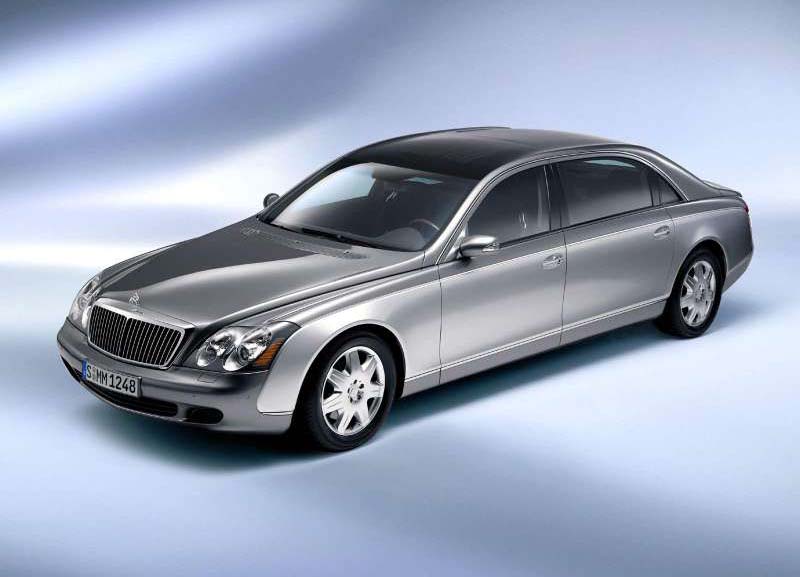
Maybach 62, 2002

Maybach 62, 2002


The Maybach 57 and 62 were the first automobile models of the Maybach brand since the brand's revival by DaimlerChrysler. They are derived from the Mercedes-Benz Maybach concept car presented at the 1997 Tokyo Motorshow (which was based on the Mercedes-Benz S-Class sedan).

DaimlerChrysler attempted to buy the Rolls-Royce/Bentley marque when Vickers offered the company up for sale. When this attempt failed (they were outbid by BMW and Volkswagen respectively) they introduced the Maybach as a direct challenger in 2002. Both models are variants of the same ultra-luxurious automobile. The model numbers reflect the respective lengths of the automobiles in decimetres; the 57 is more likely to be owner-driven while the longer 62 is designed with a chauffeur in mind. The engine is a Mercedes-sourced 5.5-liter twin-turbo V12, generating 550 hp. The prices range from US$305,000 to $357,000 (£240,000 to £250,000)—priced to directly compete with top-of-the-line Bentley and Rolls-Royce automobiles.

As of 2004, only 600 units had been sold. DaimlerChrysler projects that they may sell less than the 1,000 units expected. Just 152 Maybachs were sold in the United States in 2005, with worldwide production down to 300 units.

Maybach 57 S
DaimlerChrysler revealed the Maybach 57 S at the 2005 Geneva Motor Show. It uses a 6.0 L version of the V12 engine manufactured by Mercedes-AMG. Power output is 604 hp (450 kW) and 738 ft·lbf (1000 N·m), providing a sub-5 second sprint to 60 mph (97 km/h). It also rides 0.5 in (13 mm) lower on 20 in (508 mm) wheels. The North American unveiling was at the Los Angeles Auto Show in January 2006.

Saturday, February 12, 2011

Hummer H1 10th Anniversary Edition, 2002

Hummer H1 10th Anniversary Edition, 2002


The Hummer H1 is a civilian vehicle based on the High Mobility Multipurpose Wheeled Vehicle (HMMWV), popularly known as the Humvee, which was created by AM General.

History
Originally released in the civilian market in 1992, the Hummer H1 owes its birth to the popularity of photos from Operation Desert Storm and the enthusiastic campaign from actor Arnold Schwarzenegger, who personally owns several variants of Hummer vehicles. GM announced that 2006 would be the last model year for the Hummer H1 with production winding down in June 2006, due to a new emission laws for Diesel engine vehicles which take effect in 2007. No version of the Hummer H1 ever produced would meet these new standards. AM General currently has orders for an excess of 50,000 new HMMWVs to be produced between 2006-2009 for the United States Military. AM General also will continue to produce the H1, just not the Alpha. These vehicles will be sold through Fleet sales. The next H1 will most-likely bear a refined version of the prior 6.5L Turbo Diesel engine, but that has not been confirmed. Selling the H1's through fleet sales will allow the AM General to not be subjected to the new emission rules and regulations. AM General has sufficient fleet orders to produce 600-800 units per year right now.

Specifications
The Hummer H1 has three common variants: a convertible-like soft top, a four-door hard top pickup truck and a Wagon body version. Other less known variants include a two-door pickup truck and a four-door slantback. At this time, the convertible/soft top and the station wagon versions are the only ones available in the mass market. The two door and four door pickup versions are only available in fleet livery.

Five engine types and three automatic transmission types can be found in Hummer H1s. The common engine/transmission combinations are:
    * 6.2 L Detroit Diesel V8/GM TH400/3L80 3-speed
    * 6.5 L Detroit Diesel V8/GM 4L80-E 4-speed
    * 5.7 L Vortec 5700 gasoline V8 TBI/GM 4L80-E 4-speed
    * 6.5 L turbo Detroit Diesel V8/GM 4L80-E 4-speed
    * 6.6 L Duramax LLY turbo Diesel/Allison 1000 5-speed (model year 2006)

The Hummer H1 shares some common driveline parts with its HMMWV brethren. Items like brakes, differentials, frame and major body panels (hood, tailgate and quarter panels) are identical between the HMMWV and the Hummer H1. All Hummer H1s and HMMWVs come off the same first stage assembly line, and then are separated midway to either become a military HMMWV or a civilian H1.

Hummer H1s are unique in the way they handle off road. They are inherently very stable, thanks to their wide stance. They also can ford 30 inches (76 cm) of water, climb a 22-inch (56 cm) step, have a stock ground clearance of 16 inches (41 cm) (thanks to its design of tucking driveline components inside a channel, which subsequently intrudes into the cabin space of the vehicle), have approach/departure angles of 72/37.5 degrees and most H1s are equipped with Central Tire Inflation System (CTIS), which enables the driver to increase or decrease the tire air pressure at will.

Hummer H1s have many unusual features. They use inboard brakes. They have geared hubs, allowing the drivetrain's half shafts to be up high for greater clearance. The radiator is up high, sloping back over the engine. Rather than using simple runflat tires, aluminum or rubber inserts are an optional feature for runflat ability. A central tire inflation system is available as an option. Chemical warfare resistant paint is available only on the military version.

Friday, February 11, 2011

Hummer H2 SUV Concept, 2002

Hummer H2 SUV Concept, 2002


The H2 is the second vehicle sold under the Hummer marque of General Motors. It is a large SUV (though smaller than the Hummer H1) with room for five passengers and substantial off-road ability. The rearmost part of the H2 SUV was modified to a pickup truck bed for the 2004 H2 SUT ("Sport Utility Truck").

Overview
The H2 is built under contract by AM General at a specially constructed plant in Mishawaka, Indiana, USA. Although it shares GM's GMT820 truck platform with the Chevrolet Tahoe and GMC Yukon, those vehicles differ in many ways and are constructed in three other GM plants. The H2's final frame assembly is made up of 3 sections: The front uses a modified GM 2500-Series utility frame, the mid-section is all new and is completely boxed, and the rear section uses a modifed GM 1500-Series frame which is upgraded for the 8000 pound (3629 kg) gross vehicle weight.

H2 sales were initially strong, but fell to 28,898 for 2004 and 23,213 for 2005.
The H2 was nominated for the North American Truck of the Year award for 2003.

Engine
2003–2005 6000 6.0 L (366 in³) V8

Capabilities
With its high ground clearance, large tires, protective underbody plates, and low gearing, the H2 is capable of climbing over a 20-inch-high (0.4 m) step-up wall. A massive truck frame and wide track offer stability against overturning compared to some of the more common light truck SUVs, although objective tests have not been performed by the government or other outside parties due to its specialised vehicle class.

Fuel economy
For typical travel on improved roads, users report fuel economy of between 10 and 14 miles per gallon, which converts to between 14 and 17 L/100 km. Worst case urban driving is said to be in the range of 8 to 14 U.S. mpg (21 to 25 L/100 km). Although General Motors does not provide official H2 fuel economy ratings, most reviews have observed high single to low double-digit mileage, similar to the numbers above.

It should be noted that other large vehicles also have poor fuel economy especially with optional larger engines including the Dodge Ram 1500 series pickup trucks equipped with either the 8.3L V10 (MSRP US$48,500) or the 4.7L V8 Flexible Fuel engine running E85 fuel (MSRP US$31,300). Both of these engines are rated at 9 U.S. mpg city and 11 U.S. mpg highway by the E.P.A. as one example.

Tax benefits
Under the United States income tax code, the cost of vehicles over 6,000 pounds (2722 kg) can be deducted from income. This deduction was enacted decades ago to assist self-employed people in purchasing a vehicle for business use. The weight minimum was intended to limit the deduction to commercial-type trucks. For many years, the deduction remained below the average cost of a new vehicle, since large trucks were relatively inexpensive. Since it is a reduction in taxable income, the actual value of this deduction averages 30% of the price of the vehicle in question.

The increasing popularity of these vehicles in the last decade, however, pushed their average price to nearly double the average passenger car cost. In response, the 2002 Tax Act increased this "Section 179 depreciation deduction" to US$75,000, and it rose again to US$102,000 for the 2004 tax year. This is more than three times the current average cost of a passenger car in the United States and covers a large number of luxury models, including the Hummer H2. In late 2004, the deduction was again reduced to US$25,000.

Hummer H, 2002

Hummer H, 2002


The Hummer H1 is a civilian vehicle based on the High Mobility Multipurpose Wheeled Vehicle (HMMWV), popularly known as the Humvee, which was created by AM General.

Specifications
The Hummer H1 has three common variants: a convertible-like soft top, a four-door hard top pickup truck and a Wagon body version. Other less known variants include a two-door pickup truck and a four-door slantback. At this time, the convertible/soft top and the station wagon versions are the only ones available in the mass market. The two door and four door pickup versions are only available in fleet livery.

Five engine types and three automatic transmission types can be found in Hummer H1s. The common engine/transmission combinations are:
    * 6.2 L Detroit Diesel V8/GM TH400/3L80 3-speed
    * 6.5 L Detroit Diesel V8/GM 4L80-E 4-speed
    * 5.7 L Vortec 5700 gasoline V8 TBI/GM 4L80-E 4-speed
    * 6.5 L turbo Detroit Diesel V8/GM 4L80-E 4-speed
    * 6.6 L Duramax LLY turbo Diesel/Allison 1000 5-speed (model year 2006)

The Hummer H1 shares some common driveline parts with its HMMWV brethren. Items like brakes, differentials, frame and major body panels (hood, tailgate and quarter panels) are identical between the HMMWV and the Hummer H1. All Hummer H1s and HMMWVs come off the same first stage assembly line, and then are separated midway to either become a military HMMWV or a civilian H1.

Hummer H1s are unique in the way they handle off road. They are inherently very stable, thanks to their wide stance. They also can ford 30 inches (76 cm) of water, climb a 22-inch (56 cm) step, have a stock ground clearance of 16 inches (41 cm) (thanks to its design of tucking driveline components inside a channel, which subsequently intrudes into the cabin space of the vehicle), have approach/departure angles of 72/37.5 degrees and most H1s are equipped with Central Tire Inflation System (CTIS), which enables the driver to increase or decrease the tire air pressure at will.

Hummer H1s have many unusual features. They use inboard brakes. They have geared hubs, allowing the drivetrain's half shafts to be up high for greater clearance. The radiator is up high, sloping back over the engine. Rather than using simple runflat tires, aluminum or rubber inserts are an optional feature for runflat ability. A central tire inflation system is available as an option. Chemical warfare resistant paint is available only on the military version.