Showing posts with label 2001. Show all posts

Thursday, April 14, 2011

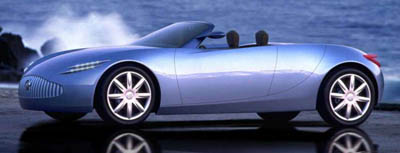
Buick 2-2 Bengal Roadster Concept, 2001

Buick 2-2 Bengal Roadster Concept, 2001


 The inside, Bengal's leather seating gives driver and passengers the feel of comfortable club chairs, said Lyon. Also, leather inserts grace the wood steering wheel.

Powerful V6 with Six-Speed Auto Transmission
Bengal owes some of its exceptional handling and sculptural exterior appearance to an innovative powertrain. Its supercharged, 3.4-liter V6 engine, which generates 250 horsepower, is transverse-mounted with the six-speed automatic transmission in front of it, rather than behind. This new drivetrain creates a shorter front overhang and a more rearward center of gravity that gives Bengal great handling on curves.

Voice Activated Controls, Head-Up Display
Quiet Servant, first shown on Buick's LaCrosse and Cielo concepts, is back -- featuring voice- activated controls from Visteon Corporation and a reconfigurable, color head-up display that shows gauges on demand. This enables the driver to control the car and its systems with voice commands or a four-position joystick on the steering wheel. As a result, the dashboard is simple and elegant and the driver operates the car with both hands on the wheel and eyes on the road.

Freed of the usual gauges and knobs, the entire dashboard is in fact one large flat-panel speaker from NXT Audio, anchoring Bengal's premium audio system. Altogether, there are five of these unobtrusive speakers which envelop the interior in audiophile-quality sound.

Buick Blackhawk Concept, 2001

Buick Blackhawk Concept, 2001


The Blackhawk is the ultimate expression of Buick. It has classic styling combined with contemporary proportions.
Retractable convertible with styling from the '30s
The Blackhawk is basically a 2-plus-2 convertible with a retractable top, and a body that looks like it came out of the late 1930s or '40s - because it did. Its face is a classic 1939 Buick grille, which has a pattern of fine vertical bars, and its major sheet metal combines the sleek bodies of 1941 and 1948 Buick Roadmasters.

All of this except the grille has been modified, and the final appearance - featuring black cherry paint, doors without handles and hidden headlamps - is of a streamlined yet retro head-turner that looks like it was created specifically for the Woodward Dream Cruise.

Blackhawk power: 463-hp V-8; 0-60 in under 5 seconds
The Blackhawk's performance goal is 0-60 miles per hour in under 5 seconds. Its powertrain is a 1970-vintage 455-cubic-inch Buick GS Stage III V-8 engine, heavily detailed and mated to the latest electronically controlled four-speed automatic transmission. The naturally aspirated, overhead valve, fuel-injected engine generates 463 horsepower at 4600 rpm and 510 lb-ft of torque at 4200 rpm.

Hand-made components
Many of the Blackhawk's major components are hand made, such as the frame, the unique carbon-fiber top and the retractable system that lowers the top into the trunk (leaving a small luggage area).

Other features include a fully independent suspension, remote keyless entry (so you can open the doors, which don't have exterior handles) and dual exhaust with three-inch pipes. The Blackhawk is equipped with 18-inch five-spoke alloy wheels (a style similar to those on uplevel Rivieras, Wildcats and Skylarks of '65) with high speed, Z-rated tires -- P295/35R18 on the front and P295/45R18 on the rear.

As an accent complementing the exterior design, a slightly different shade of dark cherry is used to create a "sweepspear" along the sides of the body. The sweepspear is a decoration that first showed up on some '49 Roadmasters and later became a shape sculpted into the sides of '50s Buicks. It's basically a horizontal line that sweeps in a downward curve along the doors toward the base of the leading edge of the rear fender, then kicks up over the rear wheel openings.

Emphasizes industry first for Buick: Lighted turn signals
While the Blackhawk looks to be from somewhere in time, it's hard to pin down where. Borrowed from the same 1939 Buick that donated the grille, a lighted logo device in the middle of the trunk exterior incorporates turn signals - a reminder that this particular '39 Buick feature was the industry's first production turn signal. Borrowed from contemporary technology, the Blackhawk is equipped with Global Positioning System navigation tied to a liquid crystal display screen.

And borrowed from a 1996 Buick Riviera - one of the most luxurious of all Buicks -- is the heavily modified Blackhawk interior. That includes buff color leather for the door trim and seats, plus design of the instrument panel and center console (though the wood-rimmed steering wheel is unique).
Even the name is borrowed. Buick introduced a subcompact Skyhawk for 1975 and the hawk symbol became an icon for the entire Buick line through the 1980s.

Monday, April 4, 2011

Isuzu Axiom-XSF Concept, 2001

Isuzu Axiom-XSF Concept, 2001


Isuzu Axiom-XSF Concept, 2001

Sunday, March 6, 2011

Oldsmobile Aurora Indy Pace Car, 2001

Oldsmobile Aurora Indy Pace Car, 2001

 
The Oldsmobile Aurora was a luxury automobile made by the Oldsmobile division of General Motors and launched in 1995 to replace the discontinued Toronado 2-door personal luxury coupe. It was a luxurious 4-door sedan riding on the same Cadillac-derived G platform as the 2-door Buick Riviera. Since the demise of the Ninety Eight in 1996, the Aurora became the flagship Oldsmobile. Also, in a way it is the successor of the Ninety-Eight or the Eighty-Eight (at least for 2000). A V6-powered version was introduced in 2001 to supplant the Eighty-Eight and the LSS. It was introduced to bring new life to Oldsmobile, but the first few years of Aurora did not even feature the Oldsmobile name. There was even a rumor at the time that the name of the whole Oldsmobile marque would be changed to simply "Aurora."

Second Generation
Oldsmobile's original intention for the second generation was to move the Aurora further upmarket, retaining its V8-only drivetrain and sharing a platform with the new Buick Riviera, as the original Aurora had done. This would have created more room within the Oldsmobile lineup for a four-door Eighty-Eight successor known as the Antares. However, Buick dropped its Riviera development plans and fiscal trouble found Oldsmobile, so Oldsmobile was forced to re-engineer the Antares into an acceptable Aurora in short time. The Aurora was downsized as the successor for the H-body Eighty-Eight on the short-wheelbase G-body (on which the Buick LeSabre and Pontiac Bonneville joined, as they used to be on the H-body). The 2001 Aurora is the product of that re-engineering.

The second-generation Aurora used a new, less-expensive version of the G platform with a shorter wheelbase. Unlike the original Aurora, this platform was shared with other GM divisions, with Buick offering the Park Avenue and LeSabre, and Pontiac offering the Bonneville.

Oldsmobile also offered a V6 engine in the Aurora for the first time. The V6 in question was the LX-5, a cut-down relation of the DOHC Aurora V8, dubbed the "Shortstar." The V6-powered Aurora was produced for the 2001 and 2002 model years only, with production ceasing in mid-2002.

The second generation Aurora went into production on November 10, 1999. The last Aurora 3.5s rolled off the assembly line on June 21, 2002. The Final 500 Aurora 4.0s ended production on March 28, 2003. The Orion, Michigan plant built a total of 71,722 second-generation Auroras (53,640 in 2001, 10,865 in 2002, 7,217 in 2003).

Engines
    * 2001-2002 LX5 3.5 L (214 in³) V6, 215 hp @ 5600 rpm, 230 ft·lbf torque @ 4400 rpm.
    * 2001-2003 L47 4.0 L (244 in³) V8, 250 hp @ 5600 rpm, 260 ft·lbf torque @ 4400 r

Oldsmobile Alero, 2001

Oldsmobile Alero, 2001


The Oldsmobile Alero was introduced in spring 1998 as a 1999 model to replace the Achieva and Cutlass. The Alero went into production on April 6, 1998. All Aleros were built in Lansing, Michigan. The Alero was Oldsmobile's last compact car as well as the last vehicle sold under the brand. Production ended on April 29, 2004.

In 2003, the Alero's daytime running lights were changed from high-beam to low-beam.

The Alero was also sold in select European countries as the Chevrolet Alero, although only available as a sedan. The car still featured its Oldsmobile badges even though sold under the Chevrolet brand, since most European consumers would not recognize what the badge stood for. Chevrolet badges were added to the grille and rear fascia during the 2000 model year. The Toronado was sold similarly.

Alero production ended with a special Final 500 Edition. These last 500 Aleros featured custom graphics inspired by vintage Oldsmobile logos, dark cherry metallic paint, and a plate featuring the car's number out of 500.

The final Alero Final 500 Edition (#500 of 500) also happened to be the final Oldsmobile ever built, and was signed under its hood by the employees of the General Motors Lansing plant and then given to the R.E. Olds Transportation Museum.
A preview of the planned replacement for the Alero was seen in 2001 with the unveiling of the "O4" concept, designed by Bertone. The car was an open top 4-seater with European styling but some Oldsmobile traits, and powered by the latest Ecotec I4 engine. The name had multiple meanings, including "Oldsmobile 4-Seater" as well as implying the year 2004 as a planned date for production.

Unfortunately, the O4 concept was unveiled a few weeks after General Motors announced that they would be phasing out the Oldsmobile brand, meaning that production possibilities of the O4 would never see reality. Because of this, a second generation Alero was never built and the car was phased out in 2004.

Engines
    * 1999–2004 LA1 3.4 L (207 in³) V6 – 170 hp (Optional on GL, Standard on GLS)
    * 1999–2001 LD9 2.4 L (146 in³) I4 – 155 hp (Standard on GX & GL)
    * 2002–2004 Ecotec 2.2 L (134 in³) I4 – 140 hp (Standard on GX & GL)

Variant prototypes
General Motors commissioned the construction of Alero prototypes either for testing or to gather public opinion on possible future plans for the Alero. These variants include:

    * Alero OSV - "Oldsmobile Speciality Vehicle", an experiment in an aftermarket parts brand for Oldsmobile. Featured a body kit, supercharged I4, custom interior, and special cherry red paint.
    * Alero OSV II - Another experimental vehicle, this time featuring an LX5 DOHC 3.5L V6 (used in the Oldsmobile Intrigue and Aurora and featured custom dark green paint.
    * Alero 442 - A set of show cars based on the Alero coupe fitted with a body kit similar in design to the Oldsmobile 442. Each Alero 442 show car had a unique color, including white with gold stripes and white with pink stripes.
    * Alero California - A custom built version of the Alero coupe featuring racing parts including a large rear wing, racing seats, sport tires, and custom graphics painted in brown and yellow.
    * Alero Convertible - An experiment in the possibility of creating an Alero with a convertible soft top to help broaden the appeal of the car to young buyers. The Oldsmobile O4 concept also hinted that the next generation Alero could have had a convertible model.
    * Alero Pace Car - Built by General Motors as part of their fleet of Oldsmobile safety cars for the Indy Racing League, featuring custom yellow and white checkered flag graphics.

Friday, February 25, 2011

Oldsmobile Aurora, 2001

Oldsmobile Aurora, 2001


The Oldsmobile Aurora was a luxury automobile made by the Oldsmobile division of General Motors and launched in 1995 to replace the discontinued Toronado 2-door personal luxury coupe. It was a luxurious 4-door sedan riding on the same Cadillac-derived G platform as the 2-door Buick Riviera. Since the demise of the Ninety Eight in 1996, the Aurora became the flagship Oldsmobile. Also, in a way it is the successor of the Ninety-Eight or the Eighty-Eight (at least for 2000). A V6-powered version was introduced in 2001 to supplant the Eighty-Eight and the LSS. It was introduced to bring new life to Oldsmobile, but the first few years of Aurora did not even feature the Oldsmobile name. There was even a rumor at the time that the name of the whole Oldsmobile marque would be changed to simply "Aurora."

Second Generation
Oldsmobile's original intention for the second generation was to move the Aurora further upmarket, retaining its V8-only drivetrain and sharing a platform with the new Buick Riviera, as the original Aurora had done. This would have created more room within the Oldsmobile lineup for a four-door Eighty-Eight successor known as the Antares. However, Buick dropped its Riviera development plans and fiscal trouble found Oldsmobile, so Oldsmobile was forced to re-engineer the Antares into an acceptable Aurora in short time. The Aurora was downsized as the successor for the H-body Eighty-Eight on the short-wheelbase G-body (on which the Buick LeSabre and Pontiac Bonneville joined, as they used to be on the H-body). The 2001 Aurora is the product of that re-engineering.

The second-generation Aurora used a new, less-expensive version of the G platform with a shorter wheelbase. Unlike the original Aurora, this platform was shared with other GM divisions, with Buick offering the Park Avenue and LeSabre, and Pontiac offering the Bonneville.

Oldsmobile also offered a V6 engine in the Aurora for the first time. The V6 in question was the LX-5, a cut-down relation of the DOHC Aurora V8, dubbed the "Shortstar." The V6-powered Aurora was produced for the 2001 and 2002 model years only, with production ceasing in mid-2002.

The second generation Aurora went into production on November 10, 1999. The last Aurora 3.5s rolled off the assembly line on June 21, 2002. The Final 500 Aurora 4.0s ended production on March 28, 2003. The Orion, Michigan plant built a total of 71,722 second-generation Auroras (53,640 in 2001, 10,865 in 2002, 7,217 in 2003).

Engines
    * 2001-2002 LX5 3.5 L (214 in³) V6, 215 hp @ 5600 rpm, 230 ft·lbf torque @ 4400 rpm.
    * 2001-2003 L47 4.0 L (244 in³) V8, 250 hp @ 5600 rpm, 260 ft·lbf torque @ 4400 rpm.

Saturday, February 12, 2011

Rinspeed Advantige R one Concept, 2001

Rinspeed Advantige R one Concept, 2001


The challenge : guilt-free pleasure
For RINSPEED developers the goal was clear: create a strikingly designed, down-to-earth sports car that offers tons of unique driving fun with exemplary environmental friendliness. The Advantige Rone with its height of only 97cm (38") is the lowest automobile and the first sports car in the world that runs on biofuel made from kitchen and garden waste.

The design : straight from pit lane
The roots of the Advantige Rone are unmistakable even at first glance: Pure motor racing. The well-balanced combination of Formula 1 and LeMans racecars results in an unusual, highly aerodynamically efficient design with the driver at its center. The car's body lines are reinforced by longitudinal air inlets in the shape of shark gills. The rear view mirrors have been replaced by three color cameras whose images are transmitted to LCD monitors in the cockpit.

Lean : the dynamic cockpit
The most striking characteristic in the cockpit of the Advantige Rone is the central and extremely low seating position of the driver. As in earlier Rinspeed concept cars (Mono Ego and E-Go Rocket) the driver sits in the middle and - at least while driving - remains alone.

The almost reclining position of the driver allows for an extremely low body profile. The overall vehicle height is just 97cm - low enough that a stunt driver could pilot it underneath a flatbed trailer.

To improve visibility in city driving and facilitate parking, Rinspeed specialists developed the
"Dynamic Cockpit Control Concept (DCCC)".

This new and unique system allows dynamic positioning of the cockpit. Height and inclination of the cockpit - and with it the driver - are adjusted electronically according to vehicle speed: Up to 40 km/h the cockpit is automatically in the highest position. Beyond 75 km/h the cockpit is lowered by about 30 cm into its lowest position.

The cockpit also leans into turns in motorcycle fashion, governed by the centrifugal forces created by turning speed and radius. The result is a completely new turning sensation. Says Rinspeed boss Frank M. Rinderknecht, 45: "This unique combination of automobile, motorcycle and racecar cries out for the endless hairpin curves of Mediterranean coastal roads - a truly special thrill and treat."

Clean : forward-looking biofuel
The Advantige Rone with its bivalent drive concept (gasoline/biofuel) is the cleanest sports car in the world. Even fueled with compressed natural gas (CNG) the environmental advantages are impressive: Exhaust emissions are 60 to 95 percent below today's stringent emission limits for gasoline or diesel vehicles.

Even more environmental friendly is the operation with resource-conserving Kompogas. It is produced by fermenting organic waste - mostly kitchen and garden waste - and is therefore CO2 neutral. With the energy extracted from 100 kilograms organic waste the Advantige Rone will cover 100 kilometers without contributing to the so-called greenhouse effect.

This new technology is a development of the Swiss Kompogas AG in Glattbrugg. It is already in use in numerous plants around the world. Among the licensees and interested parties are companies from Switzerland, Germany, France, Austria, Japan, USA, Brazil and Australia.

A Kompogas plant with a yearly capacity of 20 000 metric tons produces the energy equivalent of 1.4 million liters (370,000 US gallons) of gasoline. If all organic waste were recycled in Kompogas plants a considerable part of individual transportation could be accomplished using CO2 neutral fuel.

Advantige : Audi Individual
Contrary to many concept cars by other tuners the Advantige Rone is not just a mere showpiece. It is a cradle for new ideas and technologies and a first glimpse of the new exclusive tuning program Advantige Audi Individual of Rinspeed GmbH, which also debuts at the Geneva Motor Show 2001. On the Advantige Rone Rinspeed GmbH for the first time presents its original split-rim 8.5 x 19-inch wheels with their unmistakable styling. The Remus tailpipes in Advantige design also make their debut on the Rone.

The technology : lightness of being
The rear-mounted bivalent 1.8-liter four-cylinder engine (16V) produces 120 hp at 5,500 rpm and delivers its maximum torque of 165 Nm at 3,000 rpm. Power is transferred to the rear axle via a five-speed manual gearbox.

The body of the Advantige Rone is made from rarely used Pre-Preg composite and lends the Rinspeed Advantige Rone extraordinary stability at extremely low weight. Thanks to this exemplary lightweight design the Swiss "shark" weighs in at a mere 750 kg. The resulting power-to-weight ratio is enough to set hearts racing _ even among pilots of exclusive Italian sportscars. Performance is correspondingly impressive: The Advantige Rone accelerates from 0 - 100 km/h in less than six seconds and has a top speed of 205 km/h.

The two-piece Advantige 19-inch wheels are independently suspended using custom-developed Eibach springs. The ample tire dimensions of the brand-new SportContact 2 by Continental (235/35 in front and 255/40 in rear) guarantee safe grip at all times. Together with the extremely low center of gravity of the vehicle, the tires allow extraordinary high cornering speeds. High-gloss chrome plated tailpipes by Remus further emphasize the sporty nature of the Advantige Rone. The cross drilled brakes disks from Derendinger guarantee safe stopping.

The interior : envy of formula pilots
The sporty interior is a captivating blend of technical functionality and creature comforts. An innovative hi-fi system by Sony delivers musical pleasure. Engine and vehicle data is displayed by two large round gauges as well as by two futuristic head-up displays from in.pro. Despite the relative confines of the interior an exclusive carpet from Rieter Automotive Systems and choice upholstery material from X-Mobil create a comfortable atmosphere. Foliatec contributed many sharp styling elements for the interior and the exterior. The conspicuous paint job by Standox in the 'Exclusive Line' hues Standox "Imola Ice" and "Catalunya Splash" changes color from blue and silver to red depending on the light angle.

The development : 100-percent Swiss
Frank M. Rinderknecht used highly advanced technology and a Swiss-based network of automotive specialists for his project. Although there is no automobile production in Switzerland to speak of, there is a very active automotive supply industry there. Many highly innovative prototypes have been developed and manufactured in Switzerland.

The Swiss engineering company Esoro was hired as general contractor for the entire project, including for project management, engineering, design and manufacturing of the Advantige Rone. Esoro completed the challenging task on schedule with the help of three of its best Swiss-based suppliers. Protoscar oversaw the design and animation on a sophisticated 3D CAD system. Logos manufactured the moulds and composite parts and Schwaller Movement Engineering - a supplier of the Sauber Formula 1 team - did the metal work. The team translated initial sketches into a fully functional prototype in just four and a half months.

Friday, February 11, 2011

Hummer H1 Alpha Concept, 2001

Hummer H1 Alpha Concept, 2001


The Hummer H1 is a civilian vehicle based on the High Mobility Multipurpose Wheeled Vehicle (HMMWV), popularly known as the Humvee, which was created by AM General.

History
Originally released in the civilian market in 1992, the Hummer H1 owes its birth to the popularity of photos from Operation Desert Storm and the enthusiastic campaign from actor Arnold Schwarzenegger, who personally owns several variants of Hummer vehicles. GM announced that 2006 would be the last model year for the Hummer H1 with production winding down in June 2006, due to a new emission laws for Diesel engine vehicles which take effect in 2007. No version of the Hummer H1 ever produced would meet these new standards. AM General currently has orders for an excess of 50,000 new HMMWVs to be produced between 2006-2009 for the United States Military. AM General also will continue to produce the H1, just not the Alpha. These vehicles will be sold through Fleet sales. The next H1 will most-likely bear a refined version of the prior 6.5L Turbo Diesel engine, but that has not been confirmed. Selling the H1's through fleet sales will allow the AM General to not be subjected to the new emission rules and regulations. AM General has sufficient fleet orders to produce 600-800 units per year right now.

Specifications
The Hummer H1 has three common variants: a convertible-like soft top, a four-door hard top pickup truck and a Wagon body version. Other less known variants include a two-door pickup truck and a four-door slantback. At this time, the convertible/soft top and the station wagon versions are the only ones available in the mass market. The two door and four door pickup versions are only available in fleet livery.

5 engine types and three automatic transmission types can be found in Hummer H1s. The common engine/transmission combinations are:
    * 6.2 L Detroit Diesel V8/GM TH400/3L80 3-speed
    * 6.5 L Detroit Diesel V8/GM 4L80-E 4-speed
    * 5.7 L Vortec 5700 gasoline V8 TBI/GM 4L80-E 4-speed
    * 6.5 L turbo Detroit Diesel V8/GM 4L80-E 4-speed
    * 6.6 L Duramax LLY turbo Diesel/Allison 1000 5-speed (model year 2006)

The Hummer H1 shares some common driveline parts with its HMMWV brethren. Items like brakes, differentials, frame and major body panels (hood, tailgate and quarter panels) are identical between the HMMWV and the Hummer H1. All Hummer H1s and HMMWVs come off the same first stage assembly line, and then are separated midway to either become a military HMMWV or a civilian H1.

Hummer H1s are unique in the way they handle off road. They are inherently very stable, thanks to their wide stance. They also can ford 30 inches (76 cm) of water, climb a 22-inch (56 cm) step, have a stock ground clearance of 16 inches (41 cm) (thanks to its design of tucking driveline components inside a channel, which subsequently intrudes into the cabin space of the vehicle), have approach/departure angles of 72/37.5 degrees and most H1s are equipped with Central Tire Inflation System (CTIS), which enables the driver to increase or decrease the tire air pressure at will.

Hummer H1s have many unusual features. They use inboard brakes. They have geared hubs, allowing the drivetrain's half shafts to be up high for greater clearance. The radiator is up high, sloping back over the engine. Rather than using simple runflat tires, aluminum or rubber inserts are an optional feature for runflat ability. A central tire inflation system is available as an option. Chemical warfare resistant paint is available only on the military version.

Sunday, January 23, 2011

Lexus SC430 Pace Car, 2001

Lexus SC430 Pace Car, 2001


The Lexus SC series is a personal luxury coupé manufactured by the Toyota Motor Corporation under the Lexus brand and sold in Japan as the Toyota Soarer. The first generation, available as the SC 300 or SC 400 was in production from 1991 until July 7, 2000. A second-generation model, the SC 430, went into production in 2001.

Lexus showcased its new sports convertible, the SC 430, at the Paris Motorshow in 2000, and the car entered production the following year. Power was provided by a 4.3 L 3UZ-FE V8 engine mated to a five-speed automatic transmission. This produces 0-60 runs around 6 seconds using the same engine found in the Lexus LS.

Lexus designers from Europe and Japan worked together to create the convertible's sleek, streamlined design. The car features a retractable aluminium hardtop, all-leather interior, and 18 in alloy wheels. It can seat four and has a base price of US$63,825.

Competitors include the Mercedes-Benz SL-Class, Cadillac XLR, and Jaguar XK, and BMW 6-series.

Saturday, January 8, 2011

Lexus LS430, 2001

Lexus LS430, 2001


The Lexus LS (sold as the Toyota Celsior in Japan, Australia, and some other countries.) is a V8-powered, rear wheel drive luxury car that serves as the flagship of Toyota's luxury Lexus division.

First generation (UF10)
UF10 I (1989)
The UF10 I LS 400 was produced from 1989 to 1994. The model introduced the Lexus nameplate to the US, and soon after won critical acclaim, becoming Wheels magazine's Car of the Year and earning a place on Car and Driver magazine's Ten Best list for 1990. T

UF10 II (1993)
For the 1993 model year, the LS 400 (now designated as the UF10 II) was introduced with larger brake rotors, standard passenger's side front airbags, larger wheels and tires, and numerous other upgrades.

Second generation (UF20)
UF20 III (1995)
Introduced in 1995, the UF20 III LS 400 was an evolutionary redesign of the LS and featured a new body that eliminated 300 lb from the previous car. The wheelbase was increased by 1.4 in, resulting in more interior and trunk space, yet the overall length of the car remained at 196.7 in. The durability of the brake system was improved as well.

The most noticeable cosmetic upgrades included a new front fascia with an increased gap between the headlights and grille, new headlights and taillights. The interior received a minor redesign with a more modern dashboard layout and the center console receiving a slight facelift.

UF20 IV (1998)
For the 1998 model year, the UF20 IV LS 400 was introduced. New interior amenities included retractable rear headrests, wood accents on the leather-bound steering wheel and gear selector, and a navigation system with a concealed antenna. A new "jam protection system" for the vehicle's windows was designed to reduce the risk of possible injury by preventing the windows from closing if an object came in between the window and the door frame. Door window controls were also added to the vehicle remote control.

Exterior updates included new five spoke wheels as well as redesigned rear view mirrors that reduced the amount of wind noise. The automatic headlights were now equipped with a delay feature that allowed the headlights to remain on while the occupants exited the vehicle.

The revised LS 400 featured Toyota's new 290 hp VVT-i UZ engine mated to a five-speed automatic transmission. The drivetrain improvements not only enabled the 3,890 lb sedan to accelerate from 0-60 mph in 6.5 seconds but also improved the vehicle's fuel economy.

Third generation (UF30)
UF30 I (2001)
For 2001, the UF30 I LS 430 was introduced. While previous LS redesigns were evolutionary, the 2001 update was a more thorough update of the model's exterior and interior. The UF30 had a completely redesigned suspension and a brand new 4.3 L engine generating 290 hp (216 kW) and 320 ft•lbf (434 N•m) of torque. Lexus claims the LS430 can run 0-60mph in 5.9 seconds. A three-inch wheelbase stretch resulted in more interior volume than the competing Mercedes-Benz S-Class and allowed the engine to be positioned farther rearward for better balance. Features such as Dynamic Laser Cruise Control, a DVD-based navigation system and heated & cooled seats became available. These and other features, such as sonar assisted parking, power rear seats with massage and a rear cooler were bundled in the 'Ultra Luxury Package.'

In the interior the most notable design changes included additional woodgrain trim on the dashboard and doors as well as the addition of an LCD screen on the center console. The exterior of the vehicle was completely new with the vehicle's dimensions increasing in terms of length and height.

UF30 II (2004)
The UF30 II was introduced in 2004. Lexus freshened the front & rear fascias and added as standard equipment previously optional features, such as a one-touch power moonroof, power rear sunshade, and lighted rear-seat vanity mirrors. Some features previously included in the Custom and Ultra Luxury packages became available separately. The transmission got an added sixth gear, and keyless 'smart access' and Bluetooth technology became optional, while a pre-collision system, similar to Mercedes-Benz's Pre-Safe, which used millimeter-wavelength radar to predict crashes and allow distance-aware cruise control, was added as an option. Other updates included different wheels, projector headlamps, and LED taillights.

The 2001 to 2006 LS 430 was the most reliable luxury sedan in the J.D. Power and Associates Initial Quality survey, and the early models of this series were the most reliable cars in the survey. In later studies of defects after 3 years of ownership, the LS 430 is also at the top of the pack. The third season of the popular BBC television program, Spooks, featured a number of Lexus LS vehicles as part of the brand's introduction in the British market.
Saturday, December 18, 2010

Mercury Cougar Zn, 2001

Mercury Cougar Zn, 2001


The generation of Cougar had a far more contemporary package, with modern DOHC 4-valve engines, a fully independent multilink suspension, and front-wheel drive. This was also the first hatchback Cougar, and the first to have its own body, unshared by any Ford. The body design used a philosophy Ford dubbed "New Edge" design: a combination of organic upper body lines with sharp, concave creases in the lower areas. The Cougar's body, and the New Edge idea in general, was introduced as a concept called the Mercury MC2 in 1997.

The 1999–2002 Cougars were available with two engine options, the 2.0 L Zetec 4-cylinder engine with 130 horsepower, and the 2.5 L Duratec V6 with 170 horsepower. Also, two transaxle options were available: the manual Ford MTX-75 transmission (the only available option with the 4-cylinder Zetec engine), or the automatic Ford CD4E transmission (available in the U.S. with either engine, although the I4/Automatic combo was extremely rare; supposedly only 500 Cougars were built with the I4/Auto combination). "Sport Package" models with the V6 featured 4-wheel vented disc brakes (from the Contour SVT), and had no speed governor installed.

Ford also prepared two high performance concept-only versions dubbed the "Eliminator", which was a supercharged version built with aftermarket available parts, and the "Cougar S", which featured new body work, all-wheel drive and a 3.0 L Duratec engine.

Interestingly, Ford also sold the generation of Cougar in Europe and Australia as the Ford Cougar, but was not a sales success—surprising given that the Mondeo sold well in many countries outside North America.

This generation never sold well. Admittedly, demand for all coupes continued to dwindle, but the sedan versions also languished in North America, suggesting that the Mondeo platform was simply not well suited there—though there is a theory that Ford did not market the Contour and its Mercury Mystique twin properly while the market for the similarly sized BMW 3 Series grew. A high-performance Cougar S (not to be confused with the concept) was discussed in the press, which was essentially a Contour SVT with a Cougar body; however, this version never made it into production. In order to help create excitement for the Cougar,

In 2002, the car offered an anniversary edition commemorating 35 years of the Cougar, the same time GM's pony cars (Chevrolet Camaro, Pontiac Firebird and Pontiac Trans Am) ended. However, Ford's restructuring plan in 2002 decided to cancel the Cougar (along with the Ford Escort, Lincoln Continental and Mercury Villager).