Showing posts with label 2003. Show all posts

Friday, May 13, 2011

Buick Rendezvous, 2003

Buick Rendezvous, 2003

 
The Buick Rendezvous, introduced in the spring of 2001 as a 2002 model year vehicle and produced through the present, is a sport utility vehicle produced by the Buick division of General Motors.

Background
Given the fact that the vast majority of SUVs were rarely taken off-pavement by their owners, much less driven under serious off-road conditions, a new type of car-based "crossover SUV" was developed that was hoped would provide all the elements that customers actually wanted from their SUVs such as cargo carrying capacity, elevated seating height and the suggestion of an active outdoor lifestyle with less of the negative attributes typically associated with traditional SUVs such as poor gas mileage, uncomfortable ride, high step-in height, propensity to roll over, etc. The formula of a car-based "soft-road" luxury SUV had proven marketable by the highly successful Lexus RX300 and was thought to be a promising new market category for Buick to exploit within this extremely profitable portion of the ever-expanding SUV category.

Technology and notable features
Buick's first truck in its lineup since 1923, the Rendezvous was billed as a combination of the best attributes of a minivan (large cargo capacity, seating for up to seven), a luxury automobile (ride, handling, smoothness) and a sport utility vehicle (truck styling and available all wheel drive).
The Rendezvous was produced at General Motors' Ramos Arizpe, Mexico assembly plant, where it shared an assembly line with the Pontiac Aztek.

In lieu of four wheel drive, the Rendezvous offered Versatrak, a full-time, fully-automatic all wheel drive system which provided sure-footed traction in the snow and wet could handle moderate off-road surfaces, but was not meant for boulder-climbing Rubicon Trail-type activities.
Like the Pontiac Aztek, the Buick Rendezvous is based on a shortened version of GM's 2nd generation U platform minivans.

Buick benchmarked their Park Avenue luxury sedan as the prototypical target for ride and handling for the Rendezvous. In order to provide a luxurious and responsive car-like ride, all Rendezvous came equipped with a fully independent rear suspension system regardless of optional content or trim level.

The Rendezvous' instrument cluster detailing featured teal illuminated needles and numbers set in a silver face accented by chrome trim rings that was meant to evoke the luxurious look and feel of an expensive watch or designer bracelet.
The Rendezvous boasted the ability to carry seven passengers when equipped with a third-row bench, a class-leading feature that Buick brought to market before its competitors.

The Rendezvous is able to carry within its interior the proverbial 4'x 8' sheet of plywood, a common and useful task most of its competitors are unable to perform.

In support of the Rendezvous' intended role as a versatile accoutrement for busy, upper-middle class people with families, it provided a center console with storage space and power points for a laptop computer as well as a separate spots to hold a woman's purse, a cell phone, pager or other small items that the owner would want to keep organized and readily accessible as well as an optional rear cargo organizer system and rear seat stereo system controls with headsets.

On the uplevel CXL model, a driver information center on the instrument panel provided the outside temperature, compass functions, a trip computer that included readings of fuel economy, range and fuel used. An optional second generation heads-up display was also available.
An optional tire inflation monitoring system provided readings of tire pressure and warned if out of the specified range was a clever feature in the wake of the Ford Explorer/Firestone debacle that was in large part attributable to underinflated tires.

Sales success
The Rendezvous was a badly needed success for Buick, given the literal die-off of its aging customer base, and singlehandedly brought a large number of younger, wealthier "conquest" buyers into Buick showrooms who otherwise wouldn't have considered purchasing a Buick.

Certainly a major contributor to the Rendezvous's success was an aggressive value-pricing strategy that made the Rendezvous $6,500 less than a comparably equipped Acura MDX and $8,000 less than the Lexus RX300.
The Rendezvous handily exceeded GM's predictions of 30,000 to 40,000 units a year by a large margin, which helped offset the poor sales of the Pontiac Aztek with which it shared its Ramos Arizpe, Mexico, assembly line.

Friday, April 15, 2011

Peugeot-Hoggar Concept, 2003

Peugeot-Hoggar Concept, 2003


Peugeot-Hoggar Concept, 2003

Peugeot-4002 Concept, 2003

Peugeot-4002 Concept, 2003


Peugeot-4002 Concept, 2003

Sunday, April 10, 2011

MG TF 160, 2003

MG TF 160, 2003


A facelift in 2002 saw the MGF rebadged MG TF. The most significant mechanical changes were the abandonment of Hydragas suspension in favour of conventional coil springs, the new design of the air-induction system that along with new camshafts produces more power than in MGF engines, and the increased by 20% tortional stiffness of the body. Various cosmetic tweaks including a revised grille, redesigned front headlights, bumpers, side air-intake grills, rear boot, etc. The MG TF was the first car of its class to be awarded a leading 4-star safety performance from EURONCAP.

The MG TF was proving reasonably popular in comparison with the best affordable sports cars. However, production was suspended in 2005 when MG Rover collapsed. Nanjing Automobile Group, which bought MG Rover's remaining assets during bankruptcy proceedings, plans to restart production of a redesigned MG TF in Longbridge and in Ardmore, Oklahoma, in early 2007. For the first time the MG TF will become available to U.S. car buyers.

When it became apparent that MG Rover no longer held the rights to its 25 and 75 models, the company's administrators, PricewaterhouseCoopers, believed the MG TF to be the company's most valuable remaining asset.

Wednesday, March 16, 2011

Daihatsu Ai Concept, 2003

Daihatsu Ai Concept, 2003


Daihatsu Ai Concept, 2003

Tuesday, March 8, 2011

Hummer H, 2003

Hummer H, 2003


The Hummer H1 is a civilian vehicle based on the High Mobility Multipurpose Wheeled Vehicle (HMMWV), popularly known as the Humvee, which was created by AM General.

History
Originally released in the civilian market in 1992, the Hummer H1 owes its birth to the popularity of photos from Operation Desert Storm and the enthusiastic campaign from actor Arnold Schwarzenegger, who personally owns several variants of Hummer vehicles. GM announced that 2006 would be the last model year for the Hummer H1 with production winding down in June 2006, due to a new emission laws for Diesel engine vehicles which take effect in 2007. No version of the Hummer H1 ever produced would meet these new standards. AM General currently has orders for an excess of 50,000 new HMMWVs to be produced between 2006-2009 for the United States Military. AM General also will continue to produce the H1, just not the Alpha. These vehicles will be sold through Fleet sales. The next H1 will most-likely bear a refined version of the prior 6.5L Turbo Diesel engine, but that has not been confirmed. Selling the H1's through fleet sales will allow the AM General to not be subjected to the new emission rules and regulations. AM General has sufficient fleet orders to produce 600-800 units per year right now.

Specifications
The Hummer H1 has three common variants: a convertible-like soft top, a four-door hard top pickup truck and a Wagon body version. Other less known variants include a two-door pickup truck and a four-door slantback. At this time, the convertible/soft top and the station wagon versions are the only ones available in the mass market. The two door and four door pickup versions are only available in fleet livery.

Five engine types and three automatic transmission types can be found in Hummer H1s. The common engine/transmission combinations are:
    * 6.2 L Detroit Diesel V8/GM TH400/3L80 3-speed
    * 6.5 L Detroit Diesel V8/GM 4L80-E 4-speed
    * 5.7 L Vortec 5700 gasoline V8 TBI/GM 4L80-E 4-speed
    * 6.5 L turbo Detroit Diesel V8/GM 4L80-E 4-speed
    * 6.6 L Duramax LLY turbo Diesel/Allison 1000 5-speed (model year 2006)

The Hummer H1 shares some common driveline parts with its HMMWV brethren. Items like brakes, differentials, frame and major body panels (hood, tailgate and quarter panels) are identical between the HMMWV and the Hummer H1. All Hummer H1s and HMMWVs come off the same first stage assembly line, and then are separated midway to either become a military HMMWV or a civilian H1.

Hummer H1s are unique in the way they handle off road. They are inherently very stable, thanks to their wide stance. They also can ford 30 inches (76 cm) of water, climb a 22-inch (56 cm) step, have a stock ground clearance of 16 inches (41 cm) (thanks to its design of tucking driveline components inside a channel, which subsequently intrudes into the cabin space of the vehicle), have approach/departure angles of 72/37.5 degrees and most H1s are equipped with Central Tire Inflation System (CTIS), which enables the driver to increase or decrease the tire air pressure at will.

Hummer H1s have many unusual features. They use inboard brakes. They have geared hubs, allowing the drivetrain's half shafts to be up high for greater clearance. The radiator is up high, sloping back over the engine. Rather than using simple runflat tires, aluminum or rubber inserts are an optional feature for runflat ability. A central tire inflation system is available as an option. Chemical warfare resistant paint is available only on the military version.

Hummer Bike, 2003

Hummer Bike, 2003


Hummer Bike, 2003

Wednesday, February 23, 2011

Lexus LX470, 2003

Lexus LX470, 2003


The Lexus LX is a full-size luxury sport utility vehicle sold by the Lexus division of Toyota. Also, it was Lexus's first SUV. It has a 4.7-liter, four-cam V8 engine with four valves per cylinder. The LX has a welded steel body and a capacity to seat eight passengers. The LX replaced the Toyota Land Cruiser for the Canadian market, because most automobile companies (except for GM, Ford and Chrysler) could not sell rebadged models in Canada, the real reason being that big expensive SUVs do not fare well with Canada. Thus, having a Land Cruiser and LX470 in the same market makes matters worse.

The LX470 shares the same floorplan and most body panels with the Toyota Land Cruiser. The current LX470 differs from the Land Cruiser only in its front optics and a more luxurious interior.

Recently, Toyota made it clear that the next LX will be completely different from the Land Cruiser. Because there isn't space for two similar SUVs in the North American market. The LX's repalcement will most likely be smaller but more luxurious than the upcoming Land Cruiser. Hence directly competing with the Range Rover.

2003 upgrades
For the 2003 model year, the Lexus LX470 received an interior refesh, new grille, redesigned wheel rims and a 5-speed gearbox (an upgrade from the previous 4-speed gearbox).

2006 upgrades
For 2006, the engine's output was increased 45 hp, boosting the total output to 275 hp. The engine provided VVT-i (variable valve timing). New LED rear taillamps, a new grille and redesigned wheel spokes were added.

Lexus IS430 Project, 2003

Lexus IS430 Project, 2003


The Lexus IS is an entry-level luxury car / compact executive car produced by the Lexus marque of Toyota Motor Corporation and originally sold as the Toyota Altezza in Japan. It was introduced as an entry-level model to slot below the ES in the Lexus lineup and to compete against the BMW 3 Series, Mercedes-Benz C-Class and Nissan Skyline/Infiniti G35 sports sedans.

The first-generation Altezza (codename XE10) was launched in Japan in October 1998, while the Lexus IS 200 made its debut in Europe in 1999 and the IS 300 in North America in 2001. The second generation IS was launched in 2006. The Lexus range of cars are very successful in North America, but it is still lagging behind its German rivals in the rest of the world.

First generation
European and North American-market Lexus IS vehicles, as well as the Japanese hatchback/station wagon version called the Gita (called Lexus IS Sportcross in the U.S. and Europe) were only available in the 6-cylinder versions. US and European sales of the Lexus IS 300 were disappointing. In the American market, after hitting a high of 22,486 units in 2001, IS sales dropped below the 10,000-unit mark in 2004. The IS200 fared better in Europe and Asia, but still fell well short of the sales volume achieved by the Mercedes-Benz C-Class and other, mostly German-made competitors.

Second generation
The IS was redesigned for the 2006 model year and was introduced in the fall of 2005. The Toyota Altezza name ceased to be used with the introduction of the Lexus name in Japan. A pre-production example of the second generation IS model was shown in the 2005 Geneva Auto Show. The slow-selling SportCross station wagon version was dropped from the lineup worldwide.
Lexus IS430 Project

For the United States, three IS models are sold by Lexus:
    * IS 250 - 2.5 L V6, 204 hp (152 kW), Rear wheel drive
    * IS 250 AWD - 2.5 L 4GR-FSE V6 with all wheel drive, 204 hp (152 kW)
    * IS 350 - 3.5 L 2GR-FSE V6, 306 hp (228 kW), Rear wheel drive

In the United Kingdom and parts of Europe, 2 models are sold by Lexus:
    * IS 250 - 2.5 L V6, 204 hp (152 kW), Rear wheel drive
    * IS 220d - 2.2 L Inline-4, 175 hp (130 kW), Rear wheel drive. Manual transmission only.

The IS 250 RWD comes standard with a 6-speed manual transmission, and a 6-speed automatic transmission is available as an option. The IS 250 AWD and the IS 350 are only available with the 6-speed automatic. A precrash system is a novelty in the market.

The IS 350's performance has been admirable, and its acceleration is class-leading. Some say this marks Lexus' first foray into the sport compact market that compares fairly well with its German competitors. However, prevailing criticisms are that its steering is not as communicative as that of the BMW 3 Series, its stability and traction control systems cannot be fully disabled, and that the higher-performance IS 350 is only offered with an automatic transmission. However, the stability control system/traction control system can be disabled through non-conventional methods by using a code during engine start. This involves starting the car with the parking brake engaged, releasing the parking brake, pushing the brake pedal twice, holding it on the second push, engaging the parking brake twice, holding it on the second, and repeating until the vehicle traction light appears on the dash. 
 

Tuesday, February 15, 2011

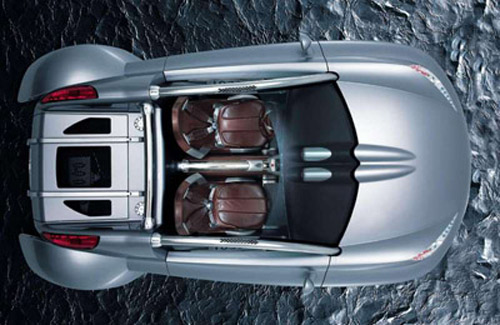
Rinspeed Porsche Bedouin 996 Turbo, 2003

Rinspeed Porsche Bedouin 996 Turbo, 2003


At the push of a button the Rinspeed Bedouin can be transformed from a roomy two-seater pick-up into a sporty yet spacious four-seater wagon sporting the trendy 'allroad' look - in less than ten seconds. With its high roofline the Bedouin also offers lots of room and seating comfort for rear-seat passengers. Even more, the increase of interior space can be used as an enclosed cargo bed by folding down the backrest of the rear seats.

The transformation trick
The almost magical transformation sequence is started by two electric motors that drive jackscrews to lift the entire roof of the vehicle. The front part of the roof then folds and in effect becomes the tailgate window while the rear part of the roof turns into the cargo bed. The tailgate is also electrically powered and can be lowered to extend the bed by another 45 centimeters to an overall length of 185 centimeters. The bed can be used to transport bulky cargo and serves as a modern tent replacement and romantic bunk for leisurely rests

To comply with highest safety standards the entire mechanism is fitted with redundant self-locking safeties and for maximum effect is operated with a remote control.

The fastest natural gas vehicle in the world
The Rinspeed Bedouin is powered by a future-oriented environment-friendly twin-turbo engine running on natural gas. Natural gas is an extremely clean-burning fuel that consists almost entirely of methane and contains almost no sulfur.

Protecting the environment does not preclude driving fun: The four-valve engine is from Porsche and produces 420 hp / 309 kW at 6,000 rpm. It delivers its impressive maximum torque of 560 Nm at just 2,700 rpm. Performance is accordingly proud: The 1,640-kg Bedouin accelerates in roughly 5.9 seconds to 100 km/h and reaches an electronically and mechanically limited top speed of 250 km/h.

Sporty thoughts
The sporty lines of the Bedouin attract attention even at first glance. It is a little reminiscent of the Porsche 911, type 996, from which it takes the 4x4 platform. In keeping with the English tradition of the 'shooting break,' the sporty wagon of the affluent hunter, the roofline exhibits a dynamic swing that gradually flattens out toward the rear. The wide rear fenders and their striking air inlets exude raw power. The large air inlets in the front provide ample cooling air and also contribute to the powerful appearance of the Bedouin.

A sporty stainless-steel exhaust from Remus with milled all-aluminum tailpipes provides the adequate sound and gives the rear a unique and dynamic look.
The elaborate roof design made from aluminum profiles is witness to the engineering prowess of Rinspeed. The entire mechanism for operating the roof is hidden from view behind the sidewalls. Green-tinted Foliatec glass in the roof louvers creates a bright and cozy ambiance even when the roof is closed.

The rearview mirrors as well as the front and rear bumpers are painted with sparkling crystal paint from Swarovski, which also contributed the fully crystal hood emblem and the rear badge featuring SDS technology.

In the Bedouin even the taillights look forward - into the future. In.pro. custom-developed chrome-plated LED taillights for the Bedouin, which not only initiate a new design trend but also offer increased traffic safety due to their exceptionally fast reaction time.
The entire body of the Bedouin is made up of Pre-Preg composite, a state-of-the-art plastic rarely used in automotive production. It combines a low specific weight with extraordinarily high strength.

Crystal worlds of leather
The Bedouin shows its proud heritage in the interior, too. Most of the interior of the Bedouin was retained from the Porsche 996 and was custom-upholstered with exquisite "Poltrona-Frau leather" from X-Mobil. The brown hue of the color "Cotto" harmonizes perfectly with the exterior color, which changes from slightly green to copper.

The Rinspeed designers also broke new ground in the selection of materials. In a partnership with the world-leading manufacturer of crystal glass Swarovski they created ultra-modern and visionary new interior elements. The hand-covered door panels shine in soft hues of brown and white. The gearshift-lever grip is made from solid crystal with a shift pattern embedded using endographics. Lasers were used to imprint the leather seats with Rinspeed logos, which were then in turn covered with crystals.

A seven-inch color LCD monitor folds down from a recessed position in the roofliner. It can display the signal from the rearview camera for the driver or entertain the passenger with the program of an integrated DVD player. The system was developed Blaupunkt and also allows connecting an external programming source such as a Sony Playstation.

Well shod
The Rinspeed Bedouin runs on voluminous fully off-road capable 18-inch Continental SportContact 4x4-tires in sizes 255/55 in front and 285/50 in the rear. The Continental tires combine environment-friendly design, exceptional off-road capabilities and excellent grip on road surfaces. The tires are mounted on two-piece Rinspeed aluminum wheels (8.5x18" Rim Offset 40 mm front, 10x18" Rim Offset 52 mm rear) custom-made by ATP.